
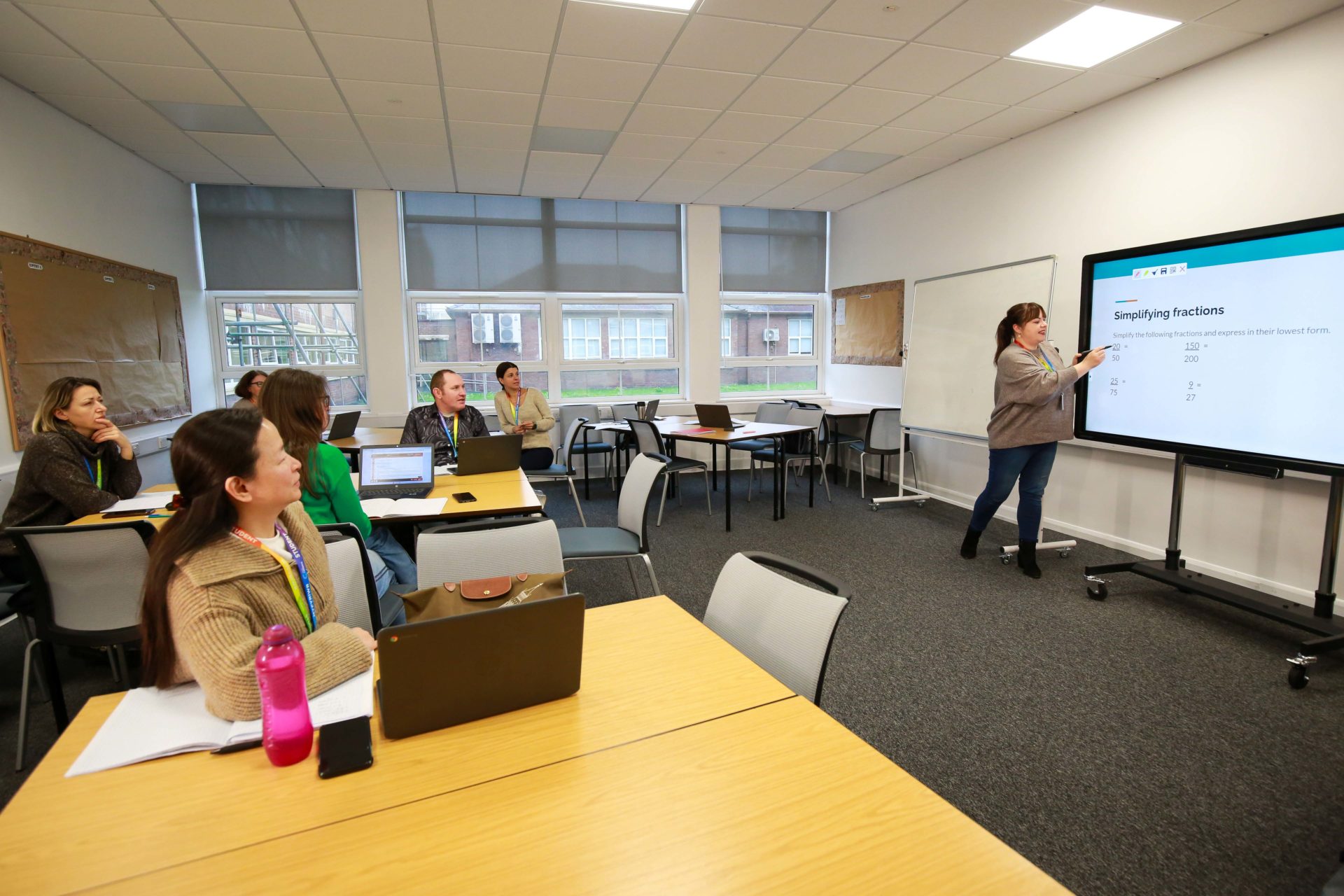
At Coleg Cambria, every full-time student is supported in developing their Maths and English skills, regardless of their starting level. Here’s how we help you achieve success:
For Students Without An A*-C (9-4) Grade in GCSE Maths And/or English/Welsh Language:
If you join without a grade A*- C (9-4) in GCSE Maths and/or English/Welsh Language, you’ll follow a tailored pathway to build your skills and achieve a formally recognised qualification.
This pathway could include:
- GCSE Courses in Maths and/or English/Welsh Language
- Essential Skills Wales (ESW) Pathways, focusing on practical Maths or English/Welsh skills
Your allocation to either GCSE or ESW sessions will depend on your vocational needs and future career or education goals.
For Students With an A*-C (9-4) Grade or Higher
If you’ve already achieved a grade A*- C (9-4) or higher in GCSE Maths and/or English/Welsh Language, Coleg Cambria offers opportunities to further enhance your skills through:
- Advanced ESW Qualifications, such as Digital Literacy or Employability Skills, designed to give you a competitive edge in the job market or higher education.
This comprehensive approach ensures every student at Coleg Cambria can advance their Maths and English abilities in a way that aligns with their goals and aspirations.
For more information, email the Skills at Cambria Team at skills@cambria.ac.uk.
The Different Qualification Types Explained
- ESW Essential Communication Skills (Comms) The Comms qualification includes speaking, listening, reading, and writing. These skills are fundamental for effective interaction in both personal and professional settings, enabling clear and concise exchanges of ideas.
- ESW Essential Application of Number Skills (Aons) Aons focuses on developing mathematical skills, including understanding and applying mathematical concepts in real-life scenarios. This is crucial for problem-solving and decision-making in everyday situations.
- ESW Essential Digital Literacy Skills (DL) DL covers essential digital skills, such as digital responsibility, navigating online environments, and using digital tools effectively. These competencies are increasingly important in today’s digital world.
- ESW Essential Employability Skills (EES) EES qualifications address workplace abilities, such as problem-solving, teamwork, and adaptability. These skills are key to thriving in professional environments and achieving career success.
| ESW | Schools in Wales and traditional GCSE grades | GCSE equivalent Grade (Grades from schools in England) |
|---|---|---|
| Entry 1 | G | 1 |
| Entry 2 | F | 1/2 |
| Entry 3 | E | 2 |
| Level 1 | D | 3 |
| Level 2 | A*-C | 4 |
WJEC GCSEs in Maths and English are available for learners who have attained a D grade. GCSEs are awarded at A*-G (9-1) grades.
Some vocational areas may elect to offer ESW as part of their programme because ESW is a recognised progression route for their vocation.
GCSE Maths
GCSE Maths focuses on problem-solving, reasoning, and practical applications. The course covers topics such as algebra, geometry, statistics, and probability. It aims to equip students with both theoretical and practical skills.
GCSE English
The GCSE English course consists of written and oral elements designed to enable learners to communicate accurately, appropriately, and effectively in both speech and writing. Learners will also explore a variety of media and develop the ability to make informed personal responses to different stimuli and texts.
For more information, email the Skills at Cambria Team at skills@cambria.ac.uk.
For more information, email the Skills at Cambria Team

Click below to discover the careers you can pursue through studying Skills at Cambria…
Free Courses
These free courses in maths and English are designed to inspire you to improve your current maths and English skills and help you to remember any areas that you may have forgotten.